Rising early, moving quickly: My time in Vietnam
Qudan Rie
Akutagawa Prize laureate Qudan Rie traveled to Vietnam in November 2025 for events in Hanoi and Ho Chi Minh, marking the publication in Vietnamese of her prizewinning novel, Sympathy Tower Tokyo. The work has garnered attention at home and abroad for its use of AI-generated text.
During her visit, Qudan participated in celebratory events for her first Vietnamese edition and also held discussions with Vietnamese artists of her generation. This was Qudan’s third time in the country, a place she had enjoyed exploring on her own years before becoming a writer.
Qudan contributed her reflections in this essay, translated for us from the Japanese by Sympathy Tower Tokyo translator Jesse Kirkwood.
See the Book Launch Event here.

Rising early, moving quickly: My time in Vietnam
Vietnam rises early. Before the sky is even fully light, the streets erupt with the revving engines and horns of scooters, the clatter of construction. As the city stirs to life around me I feel compelled to immerse myself in that frenetic hum. And so I venture out, braving the onslaught of motorbikes, guided by the aroma of phở to the stall where I order breakfast. As I slurp the noodles laden with fragrant herbs, any lingering drowsiness evaporates as my body awakens completely. In Vietnam, and only in Vietnam, I become a marginally healthier, more active person—a morning person. Or at least that was true on my first two visits to the country, five and ten years ago. This time, my third visit, things are a little different. The hotel I’m staying in, Signature by M Village, is set back from the main road and blissfully quiet. As I doze in my near-silent room, my ears catch the faint, rhythmical intonation of a street vendor’s call. If this were Japan it would be the baked sweet-potato seller making his rounds; here it is for bánh mì.
Thanks to a good night’s sleep, all traces of fatigue from the previous day’s flight are gone. I take a walk around Hoàn Kiếm Lake, a short distance from the hotel. While there do seem to be a few more tourists than I remembered, I am relieved to find the scenery not much changed. The air is crisp, and the shores of the lake are teeming: practitioners of tai chi gazing serenely across the water, groups dancing to music that blares from speakers, young people posing for photos in elegant traditional dress. As I walk, I gaze at these early risers each absorbed in their activity of choice, and at the lake surface glittering in the gentle morning sun, and almost forget about the event I have scheduled for the afternoon.
I am here because a Vietnamese translation of my novel Sympathy Tower Tokyo has been published, and the serene mood at the lake this morning reminds me of the tranquil interior I envisioned for that fictional tower. I barely described them in the novel itself, but if I were ever to write about the tower’s residents again – assured of a painless, safe and blissful existence – I would have modelled them on the people who gather around Hoàn Kiếm Lake. Lost in these reflections, I film the paradise-like scene with my phone. On my way back to the hotel, I drop by the Vietnamese Women’s Museum, expecting it to still be closed, only to discover that it has been welcoming visitors since the brisk hour of eight o’clock.
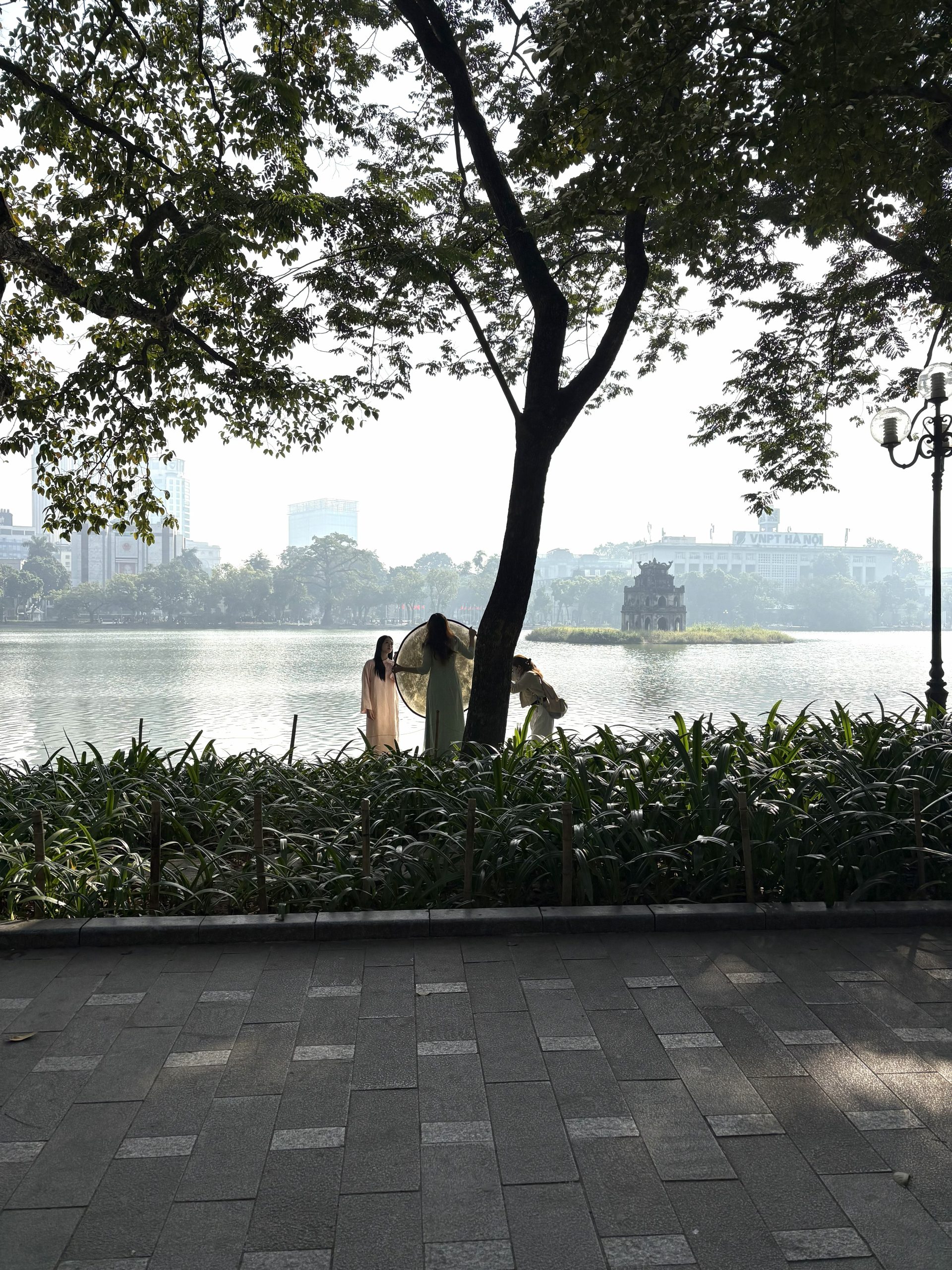
Young people photographing and posing by Hoàn Kiếm Lake at dawn
In the afternoon, before meeting up with Osuka-san from the Japan Foundation, I change into the áo dài I packed in my suitcase. The tunic—decorated with Vietnam’s national flower, the lotus—was tailored during my visit a decade ago, when I never dreamed I would one day become a writer, and its pink-on-white design feels almost too fresh and innocent for my present self. Even so, there’s something curious about it finally getting its moment in the spotlight. Through the garment, that carefree younger version of myself merges briefly with the author standing here bearing a translated edition of her own novel—two parallel selves meeting briefly, like something out of a work of fiction.
The first scheduled event of the trip is held in the bright, airy office building that is home to San Ho Books, the publisher of the Vietnamese edition. Upon arrival my eyes go straight to a huge panel depicting a woman trapped in a birdcage. This is the original illustration commissioned for the cover of the Vietnamese edition, and it is as though the novel’s protagonist has stepped off the page right into the room. I am deeply grateful for such care and effort invested in making the event a lively success (and regret, even as I write this, that the panel was too enormous to take home). The moderator is Quyên Nguyễn, a literary critic who has also translated Raymond Carver. Aided by interpreter Lương Việt Dũng, we speak at length about the work. I was warned before the event that people in Hanoi might be a little more reserved than those in Ho Chi Minh—rather like the difference between Tokyo and Osaka—but the attendees listen avidly and, when it comes to Q&A time, are quick to raise their hands.
When someone asks, “What made you want to write about a prison?” I recall my visit to Hỏa Lò Prison a decade ago. Built by the French during the colonial era, it previously housed Vietnamese political detainees, and later American POWs during the Vietnam War. These days it’s a Hanoi tourist attraction, but, as I explain to the audience, I am still haunted by its gloomy detention blocks lined with life-sized, chain-bound mannequins. As I respond, I am startled to realize that my visit there may have come, years later, to shape my novel in ways I could never have foreseen.
Osuka-san tells me that, excluding online events, this is the first time in eight years that a writer from Japan has been officially invited to the country, the last being Ono Masatsugu. When it comes to Japanese writers, Murakami Haruki is especially popular here, and his name is frequently mentioned at receptions and in media interviews during my trip. His popularity may have been bolstered by the fact that the film adaptation of Norwegian Wood was directed by the Vietnamese-born Trần Anh Hùng. My tireless interpreter in Hanoi, Lương Việt Dũng, is the translator of many works of Japanese literature, including Murakami’s The City and Its Uncertain Walls. As I repeatedly cite one of my own influences, Mishima Yukio, I learn that his name, too, is widely recognized, what with the separate volumes of his Sea of Fertility tetralogy currently being released in Vietnamese translation. At a meeting with students studying Japanese literature, the names Akutagawa Ryunosuke and Dazai Osamu come up, while Higashino Keigo seems to be a favourite among contemporary writers. Catching names like Akutagawa and Murakami amid the complex vowels and unfamiliar tones of Vietnamese sentences brings me a strange joy.

Author’s talk at San Ho Books
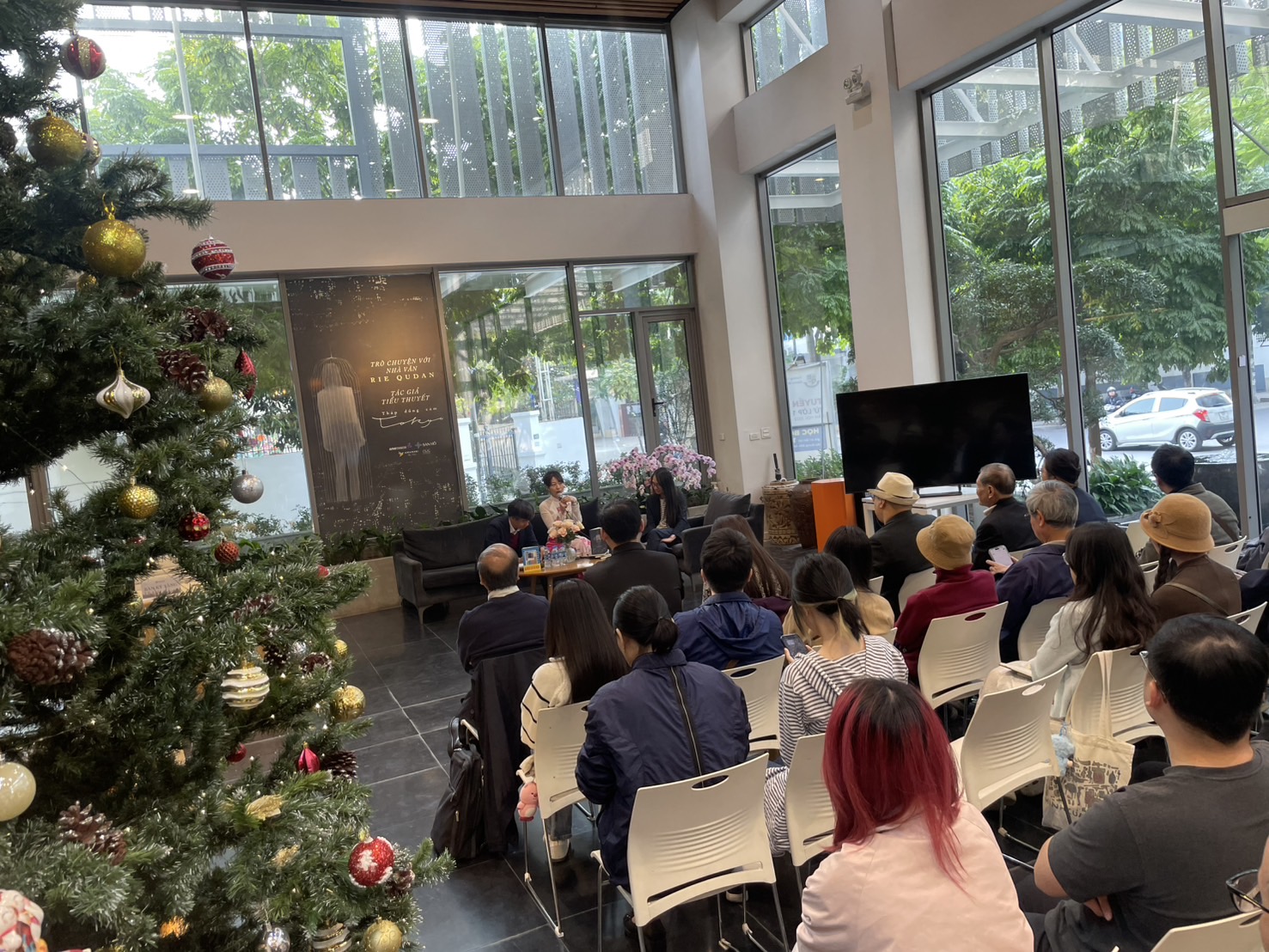
Author’s talk at San Ho Books

Greeting readers at the signing table
The second day begins at Hanoi University of Culture with a morning symposium chaired by Professor Phạm Xuân Nguyên, an eminent literary critic. The event brings together writers and students from the Faculty of Creative Writing and Journalism, as well as a prominent AI researcher, for a spirited three-hour debate. As I was expecting, the event begins at an early hour—no strolling around the lake for me today! Over the course of my trip I participate in a total of three university events, the other two at the Universities of Social Science and Humanities in Hanoi and Ho Chi Minh City respectively, and each is scheduled for the very first period of the day. I get used to awkwardly greeting people with the words: ‘Thank you all for coming in so early—although I guess this is normal for you, isn’t it?’
It isn’t just these early starts that impress me; I am struck also by how quickly articles appear in the local press. The day after an event, lengthy interviews and reports appear on news sites, complete with photos. Osuka-san notes that Vietnamese people are also very quick at responding to emails, and I find myself convinced, without any real evidence, that this speed must have something to do with their habit of rising early. Not that they come across as frenetic or unsettled; on the contrary, there’s a general air of ease, of the surplus composure that comes from being one step ahead of the day.
In the evening, I take part in a conversation with Maik Cây, an artist about my age. We discuss the relationship between real and imagined worlds, making for a deeply satisfying session. I learn that she has written a novel entitled The Museum of Hair, and we get carried away talking about body hair and depilation.
When the discussion moves on to the replacement of words within languages—an important theme in Sympathy Tower Tokyo—I ask her if any Japanese words have crossed over into Vietnamese. Her reply, “ōsin,” causes the venue to erupt with laughter. It turns out that Oshin, the heroine of a popular 1980s morning drama of the same name, is now a common Vietnamese word for a domestic helper. Conversing with an artist at a similar stage in her career is hugely stimulating. The hope that we might discuss each other’s work again someday provides me with a powerful motivation to keep making art.
After four nights in Hanoi, I move on to Ho Chi Minh. I stay in Thao Dien at the superb Amanaki Hotel, one of the sponsors for my visit, and spend most of my two free days in my room working on an ongoing newspaper column. While my memories are still fresh, I write essays about my luncheon at the Japanese Embassy and my visit to a Hanoi organization that sends technical trainees to Japan. From quite an early age, nothing has pleased me more than writing in hotel rooms. Between sessions at the keyboard, I sip lotus tea and admire the view of Landmark 81, wishing from the bottom of my heart that these days could go on and on. In a parallel world I will go on elegantly drafting manuscripts in my room at the Amanaki Hotel, exchanging silent messages with the version of myself who has returned to her hectic life in suburban Tokyo.
The final event of my time in Vietnam is another book-launch event, this time at the Japanese consulate. Đào Lê Na, a scholar of literature, kindly serves as moderator. With plenty of time set aside for questions, I enjoy lively exchanges with the audience, and, conscious that I’ll soon be heading back to Japan, am touched by the kind attentiveness of everyone present.
What does it take to make a living through art?
I want to be a writer, but I never seem to finish anything. Do you have any tips for seeing a work through to the end?
Asked these questions, I reply—as if to reassure myself as much as anyone else—that “accumulating a pile of half-written novels is not, in itself, a waste of time.” I recall how I myself once longed to be a writer, and once again my mind is shaken by memories of those eerie mannequins at Hỏa Lò Prison, and of the dark chapters of Vietnamese history embedded in that building. The group photograph taken at the end of the event, with the audience all smiling around me, is one of my most cherished mementoes from this trip.
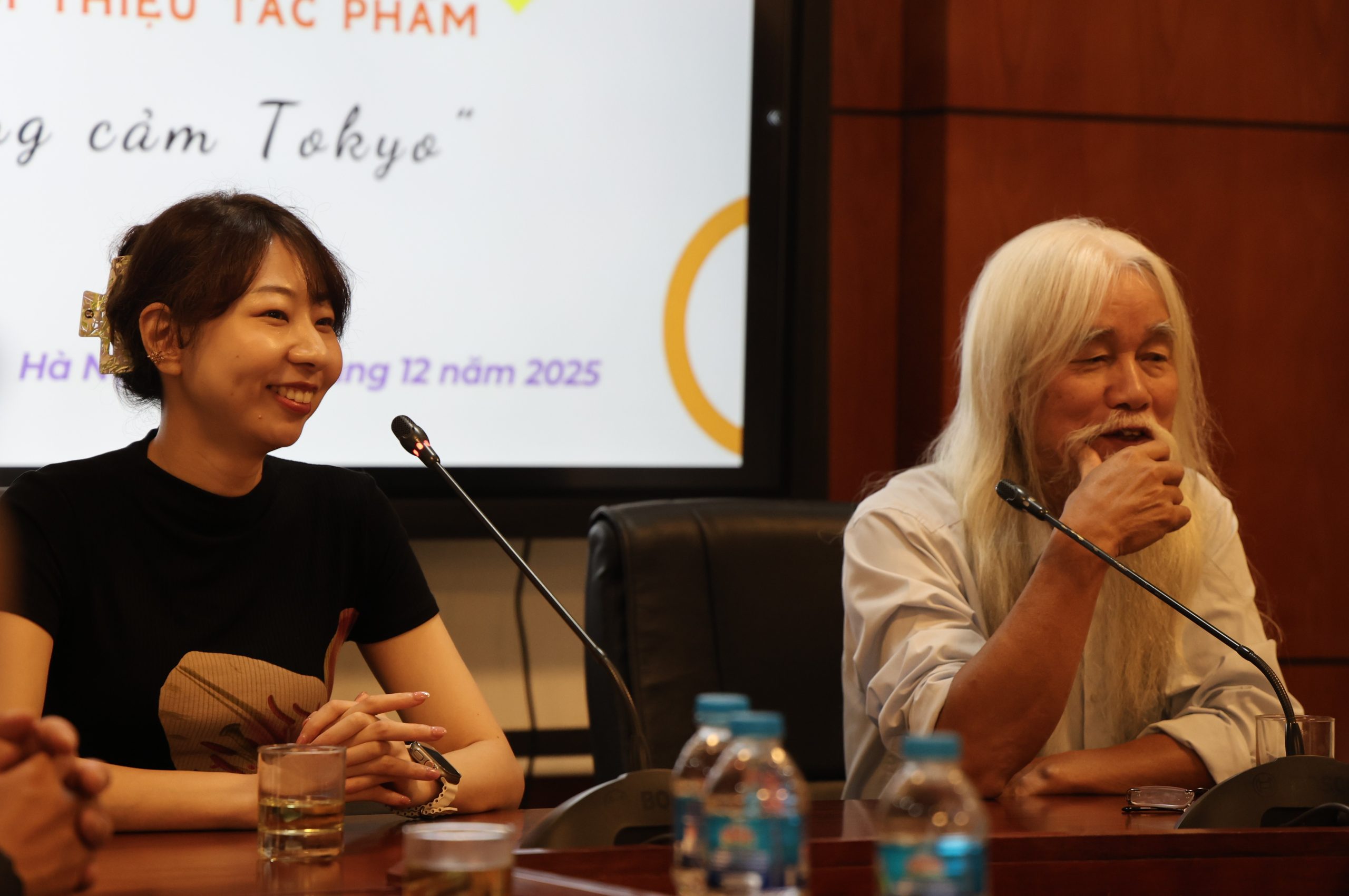
With Professor Phạm Xuân Nguyên at an exchange event at Hanoi University of Culture
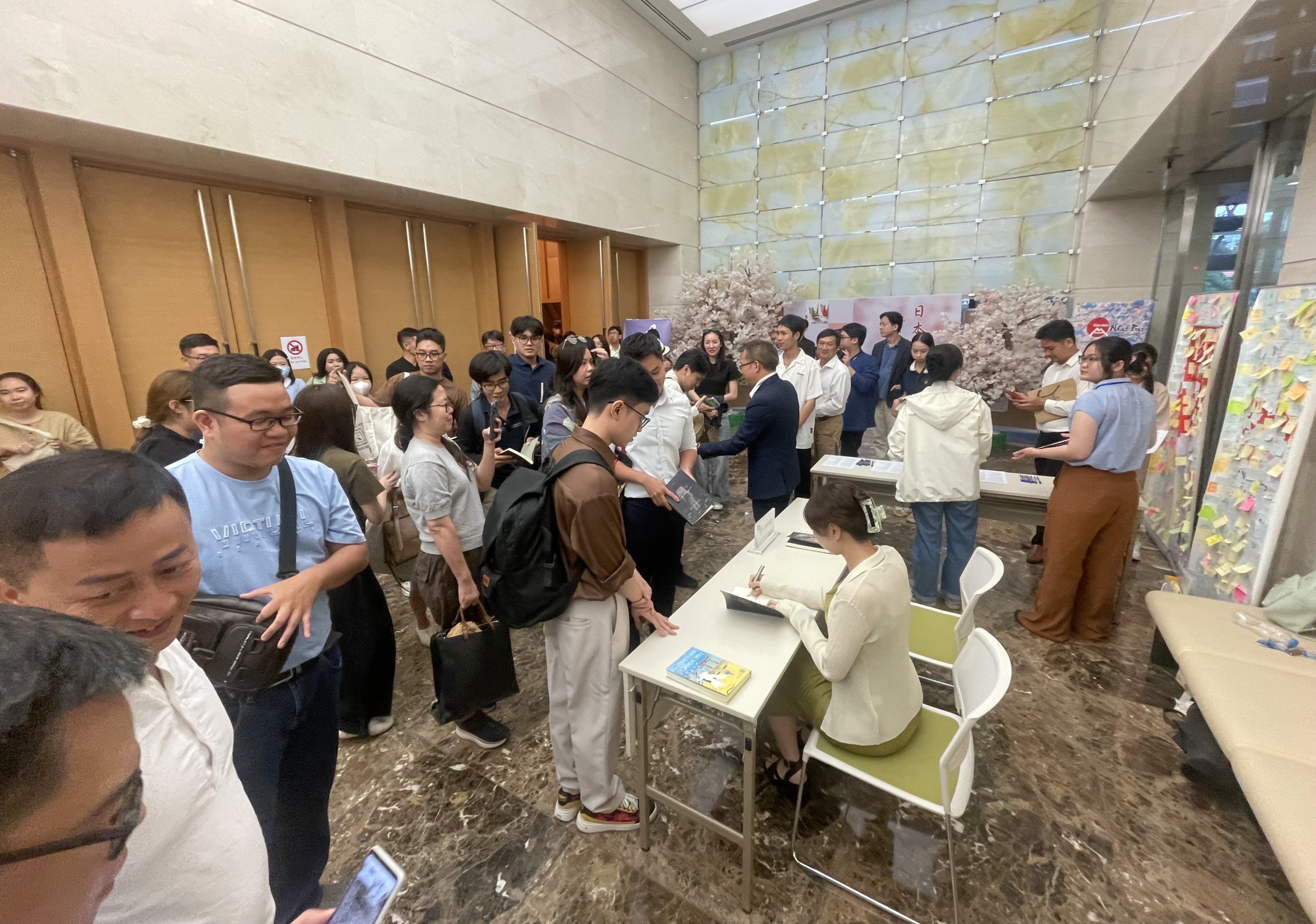
Post-talk signing at the Consulate General of Japan in Ho Chi Minh
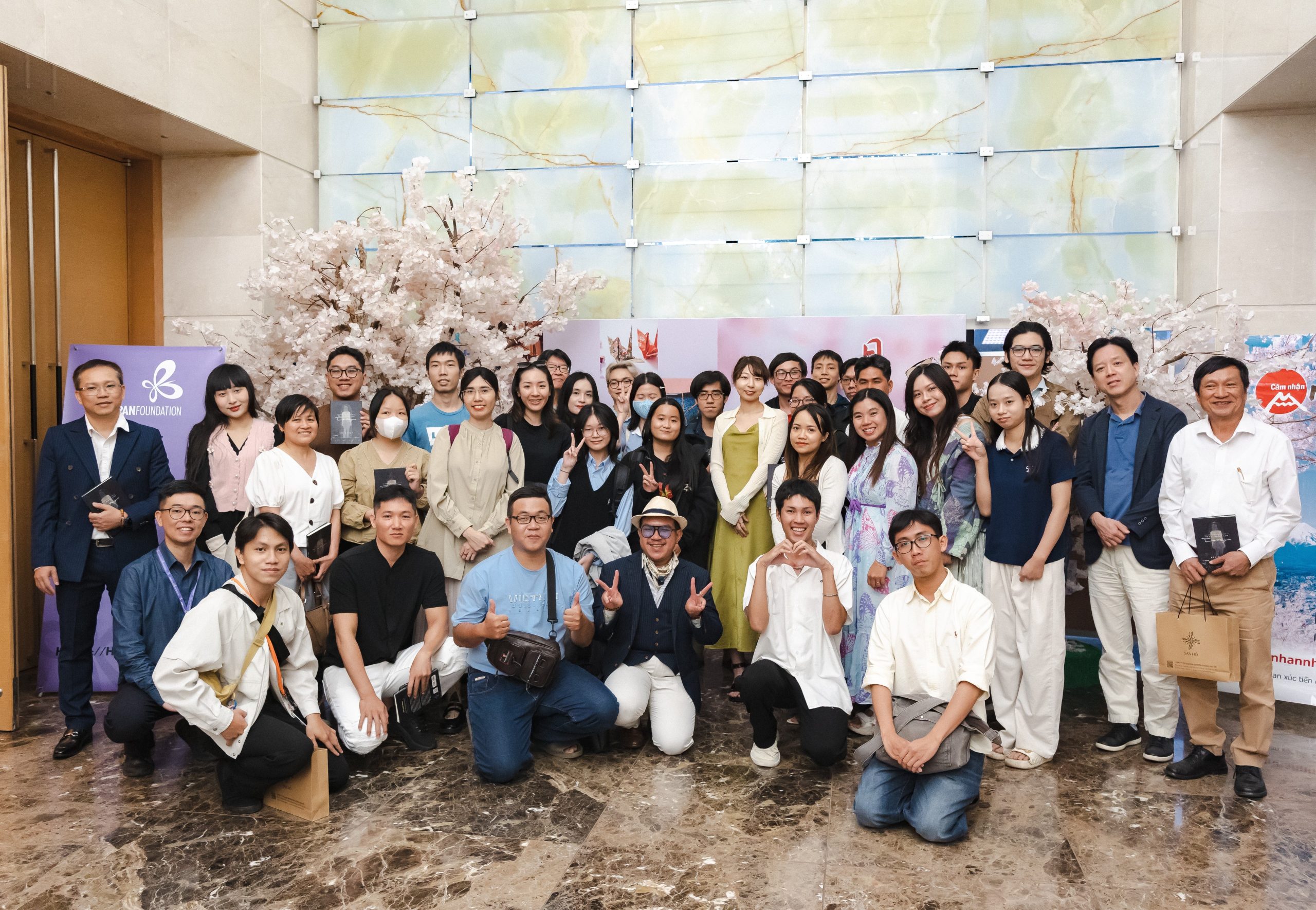
Group photograph taken at the Japanese consulate
In Japan and elsewhere, the topic of AI always gets audiences fired up, and Vietnam is no exception. Throughout my visit, it seems impossible to switch on the television without encountering another news segment on the subject, and I am struck not only by the intensity of this interest but by the positivity that surrounds it—the sense that AI will bring prosperity to the country. This isn’t just a personal hunch: a participant at one of the university events proudly informs me that Vietnam is promoting the new technology as a national project, and that an impressive proportion (I’ve forgotten the exact percentage) of AI engineers working in Silicon Valley are Vietnamese.
After I was awarded the Akutagawa Prize, I noticed that Vietnamese-language outlets were some of the earliest to give prominent coverage to my use of AI in the writing process (it seems they’re quick off the mark in this area, too). Two years ago, when my remarks on this topic at a press conference were reported all over the world, I found myself reeling at the unexpected turn of events, but there was a clear upside. Being at the centre of a topic that, for better or worse, attracts so much global attention has brought me into contact with people I would never otherwise have encountered. AI is often framed as the antithesis to physically embodied human beings. But in my case, paradoxically enough, it has transported my body to distant places and, in serving as a shared topic of discussion, enabled some very fulfilling exchanges. It feels like a stroke of incredibly good luck. Even the label “AI novelist,” which I was initially uncomfortable with, now arouses something close to affection in me. Whatever labels I am assigned, and however much controversy or antipathy I inspire, it will all be the product of the stories I have written and the words I have used. That, at least, seems like something to be proud of.
2025 will remain engraved in my memory as the most travel-heavy of my thirty-five years on this planet. After promotional trips to Taiwan in February, Italy in May, and Hong Kong in July, this trip to Hanoi and Ho Chi Minh marks the conclusion of my “Tower of Babel” year—in which, with the help of countless people, the words in my book have been scattered across a host of different languages. Toward the end of the year, a courier delivers my third áo dài, following a fitting at a shop close to my hotel in Ho Chi Minh. Slipping my arms into the new tunic, I vow to keep patiently writing, in anticipation of the day when I will be reunited with the people of Vietnam—and my parallel self. Doing my best, all the while, to keep pace with that high-octane country, which rises so early and moves so quickly it seems always to be one step ahead.