
Contemporary Japanese Authors and Their Translators: A Meeting of the Minds
In November 2025, the Japan Foundation hosted a visit to Japan by five translators and four editors of Japanese literature based in Indonesia, Thailand, Vietnam, Malaysia, and Myanmar. For more information about that professional exchange, see here.
With the cooperation of professor Yoshio Hitomi of Waseda University, during their visit a roundtable was held between author Matsuda Aoko and three translators of her works: Geywalin Likhitvidhayavuth (“Meen”) of Thailand, Asri Pratiwi Wulandari (“Wulan”) of Indonesia, and Rita Kohl, who is based in Brazil but coincidentally happened to be completing a residency at the Waseda International House of Literature at the time. Yoshio acted as moderator for the event, which was attended by graduate students from Waseda University’s Global Japanese Studies (Global-J) course and featured readings of Matsuda’s work in the four languages. A lively Q&A section and exchange of opinions were enjoyed by all. In this article we present highlights from the translators’ discussion of how they approached Matsuda’s work, along with reflections by Matsuda on the experience of being translated.
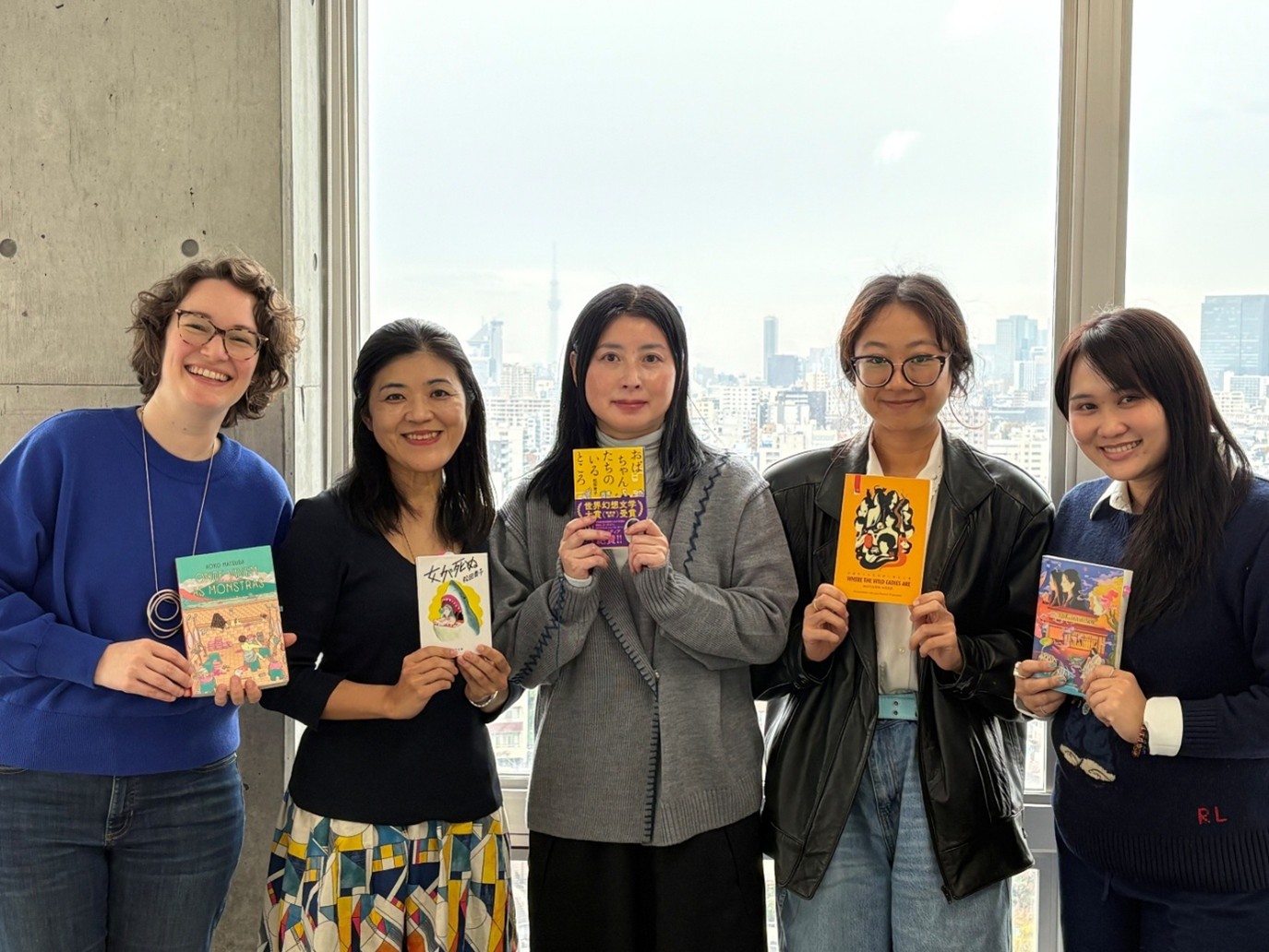
At Waseda University
Yoshio:
Thank you, everyone, for coming together for this valuable opportunity to hear from Matsuda Aoko and three translators who have made her work available to readers of Thai, Indonesian, and Portuguese. In addition to Matsuda’s Obachan-tachi no iru tokoro [trans. Where the Wild Ladies Are—hereafter Obachan-tachi], Meen has translated titles by many other Japanese authors into Thai, including Murata Sayaka, Higashino Keigo, Kawamura Genki, and Harada Maha. Indonesian translator Wulan has also translated Obachan-tachi, along with books by Imamura Natsuko, Kawakami Mieko, and early twentieth-century female authors such as Tamura Toshiko. In 2021, she released a short-story collection of her own. Finally, Rita Kohl is a Brazilian translator who is currently at the Waseda International House of Literature for one month as translator in residence. She has translated authors including Murakami Haruki, Ogawa Yoko, Murata Sayaka, Suzuki Izumi, and Tsushima Yuko into Portuguese; one of her recent translations is Kawakami Mieko’s Kiiroi ie [trans. Sisters in Yellow]. All three are taking the lead in bringing contemporary Japanese literature in translation to their respective countries. To start off, let’s hear from each of them in turn about their initial encounter of Matsuda Aoko’s work, why it appeals to them, and current publishing trends in their home countries.
At Waseda University
Seeing the World through Matsuda Aoko’s Eyes
Meen:
My first encounter of Matsuda Aoko’s work came when Eka Publishing, a newly established feminist publisher in Thailand, found me on social media and contacted me about publishing Obachan-tachi in Thai. By that point I had written a number of articles about women and their situation in Japan’s entertainment industry. I read the book and immediately accepted the offer to translate it. It’s a briskly paced, enjoyable read, and has a cynical wit that makes it hard to put down. It also has mystery and ghost-story elements, so I was sure it would sell. Thai readers love horror, so ghost stories are common and often involve female ghosts. When the Thai edition of Obachan-tachi was published I received many comments from readers saying, “This is just like Thailand,” and I’ve also heard that its sensibility is similar to that of neighboring countries such as Myanmar and Malaysia, as well.
Matsuda:
I learned that a feminist publisher had been founded in Thailand, that they wanted to publish Obachan-tachi as their inaugural release, and that the translator would be female, too. That was how I came to know Meen. I was later invited to Thailand through a Japan Foundation program on the occasion of the book’s publication, during which I participated in panels at the 51st National Book Fair and the 21st Bangkok International Book Fair [held in April 2023], where I met Meen in person for the first time. But in fact we were in touch before my trip, as I had asked her to show me some places in Thailand connected with famous female ghosts.
Meen:
Thailand is home to tales of a ghost named Mae Nak Phra Khanong, whose story is similar to that of Oiwa in the Japanese ghost story Yotsuya kaidan [The Ghost of Yotsuya]. She was a pregnant woman living alone and waiting for her husband to return from war, but both she and her baby died during childbirth. When her husband finally returns the three continue to live together as a family—he, not knowing that his wife and child are ghosts. There are several different interpretations of the ending, but ultimately he realizes the truth and has a monk perform funeral services for Mae Nak and their child, who enter Nirvana.
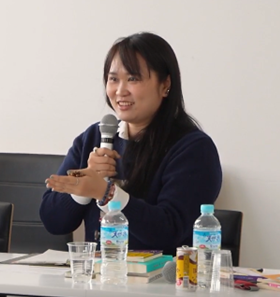
Meen, Matsuda’s Thai translator
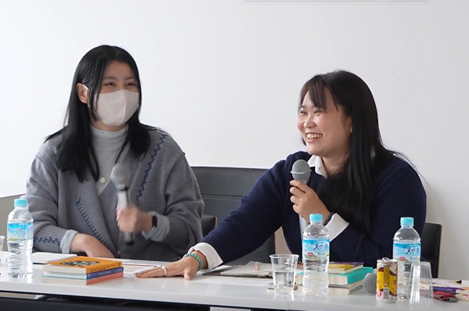
Matsuda and Meen
Matsuda:
Japan also has many ghost stories and folk tales where people live happily with supernatural beings. Meen took me to a temple where Mae Nak is enshrined, and the atmosphere there was very warm and positive. The area around the statue of Mae Nak with her baby in her arms was filled with flowers and toys, which was a truly striking sight that I doubt I will ever forget. Meen also showed me a temple, the only one like it in all of Thailand, where there are 52 statues of Buddhist nuns.
Wulan:
My first encounter of Matsuda Aoko’s work was the essay collection Romantikku agenai [I’m Not Your Romance]. When the publisher asked if I would translate Obachan-tachi, my answer wasn’t “Yes,” but rather “If you hire anybody else, I’ll never forgive you!” That was how strongly I wanted to translate it.
At the time I was learning about feminism and thinking about female ghosts. Indonesia also has a ghost culture, and this notion that women who die in childbirth become ghosts. The maternal mortality rate is still incredibly high, and I felt that female ghosts symbolize the tragedies that women in many countries have experienced. That view only strengthened my resolve to introduce this work in translation. Feminist books from inside and outside the country were just starting to be read in Indonesia at the time, and rage-filled works made up the mainstream of this movement. This rage is fully justified by the circumstances, of course, but Obachan-tachi has both anger and humor. What is this? I was thoroughly intrigued. Readers, too, have written long reviews touching on the way it expresses rage in a playful way. I think it has the potential to become a cult classic.
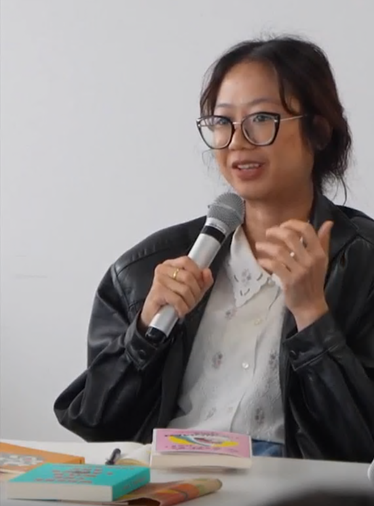
Wulan, Matsuda’s Indonesian translator
Matsuda:
I was once invited to the Makassar International Writers Festival in Indonesia. A gathering was held at the venue to protest government censorship of books, and I was moved by the sight of so many people, each with a book held high, united in their rallying cries. Attendees asked me many questions about works by Japanese women authors, and I also learned about Saman, written by the Indonesian author Ayu Utami. Unfortunately, I can’t read Indonesian, so I bought the English edition, and read the Japanese edition after returning to Japan. The energy I felt in Indonesia was very powerful and lingers in my memory to this day. I’m delighted that Obachan-tachi was translated into Indonesian, and that its translator was Wulan.
Rita:
I first encountered Matsuda Aoko’s work around ten years ago. On the recommendation of translator Jeffrey Angles, I read Eiko no mori [Eiko’s Forest] in the snatches of free time I had while caring for my grandmother at the hospital. Its worldview was entirely new to me. It revealed an entire world that can only be expressed in writing, and one that I related to easily. After that, I translated Onna ga shinu [The Woman Dies] for the Portuguese edition of Granta. It was difficult, but at the same time it was highly rewarding. At around this time, I got in touch with Matsuda via social media. Eventually a Brazilian publisher asked if I would be interested in translating Obachan-tachi. The email said, “The author says she’d like you to handle the translation,” and I remember being so delighted that I read it over and over again. Obachan-tachi was a work I had wanted to translate for some time. Interest in feminist works is rising in Brazil today, and I was sure that it would be received well. The fact that it has horror elements and is also rooted in traditional Japanese stories was also fresh. The way the women in the story are freed after long years of oppression is also highly appealing. It also has a humorous side, and the inclusion of many elements from a world and narrative context unknown outside Japan is another reason it has found such support among readers. However, I must note that, despite my repeated overtures to Brazilian publishers, they only took interest after the English edition was published. This made me realize how strong the influence of Europe and America still is.
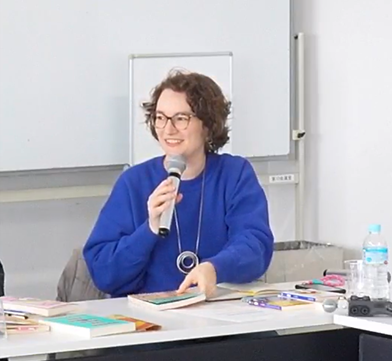
Rita, Matsuda’s Portuguese translator
Yoshio:
The English translation of Obachan-tachi by UK translator Polly Barton won many awards, including the Firecracker Award given to works by independent publishers in the US, and the World Fantasy Award. It was quite a sensation in both the US and the UK.
Matsuda:
Rita first translated Onna ga shinu into Portuguese. When Obachan-tachi was picked up for translation into Portuguese, I told the publisher that I was set on having Rita translate it. I was very happy to hear that they felt the same way. One thing that made an impression on me was that both Rita and the Spanish translator Juliana Buriticá Alzate were on friendly terms with Polly, the English translator. My door was open to questions during the translation process, but as it turned out the three of them were able to resolve many issues on their own, among themselves. It was fascinating to know that translators working in different languages were having these involved, ongoing discussions, and it made me very happy.
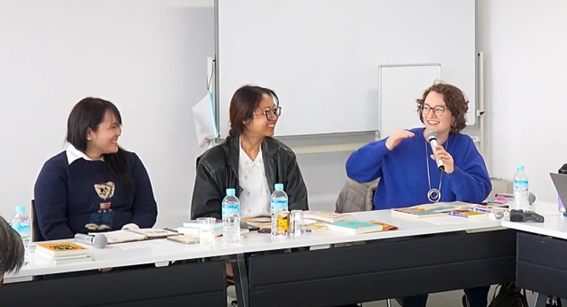
Meen, Wulan, and Rita
The Translation Process
Yoshio:
Many types of ghost appear in Obachan-tachi, and it was a lot of fun to see the differences in how each country handled them. Let’s hear one comment each from our participants about memorable moments or difficulties during the translation process.
Rita:
In the tale of “Hina-chan” [Chapter 3], I was most concerned with the onomatopoeia. Japanese words like boro-boro and doro-doro simply disappear in Portuguese, so I did my best to choose language that left a lasting impression. I still feel frustration over the impossibility of completely recreating the original, and if I had the opportunity to take another go at it, I think I’d try even harder. Another point with “Hina-chan” is that polite, old-fashioned Japanese is used, but Portuguese doesn’t have different ways of speaking that correspond to this, so I drew inspiration from older works of literature and translated these parts in somewhat old-fashioned, polite language.
Meen:
When I read “Migaki o kakeru” [Chapter 1], I felt it would be a mistake to lose the Kansai dialect entirely. I discussed this with my editor, and they commented that the people of southern Thailand might be similar to the people of Kansai in their way of thinking, so I decided to use a southern dialect in my translation. I was extremely careful about the choice of dialect, the overall atmosphere, the way the characters talked, and the nuances of their conversations. Readers have responded to this in many ways, but most found it enjoyable and appreciated what it revealed about the characters.
Matsuda:
If the ideal dialect exists, use it; if not, don’t force it—judgment calls like that are crucial. The important thing is balance: recognizing possible choices and committing to them fully. When I visited Thailand, I had the opportunity to lecture at Chulalongkorn University, and professors there lavished praise on Meen’s translation, saying it was highly accomplished and a truly exceptional effort.
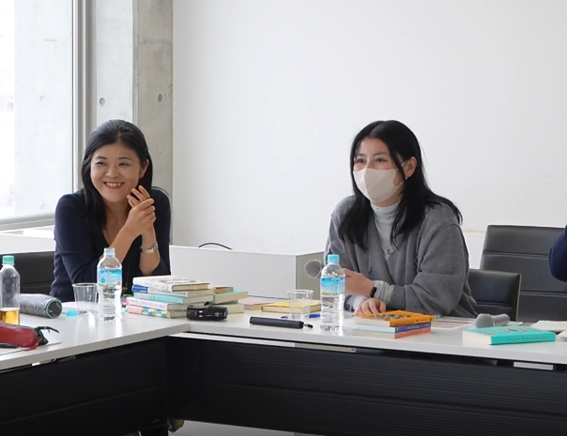
Yoshio and Matsuda
Wulan:
In my translation, the protagonist speaks like the younger residents of affluent southern Jakarta, occasionally dropping English words into sentences, while Obachan uses a more traditional way of speaking, close to standard Indonesian. I thought there might be criticism of my choice to mix English into the translation, but I did so because I thought it would allow me to convey a difference in Indonesian similar to the relationship between the Kansai and Tokyo dialects of Japanese. Many readers found this enjoyable, and I was happy that they understood what I was going for. Also, one thing I thought about in the course of this translation is that the act of translation essentially creates another version of the work. I’m from Jakarta, and the publishing house is there too, but if the book had been translated, say, in Makassar in eastern Indonesia, an eastern Indonesian dialect would have been used as a more natural fit for readers there. In short, I had to accept that I was translating the work as someone born and raised in the heart of the capital, and I was prepared to listen to criticism on those grounds.
Matsuda:
Translation is truly difficult—a job with no right answer. I do translation myself, and one thing I always feel when my work is translated is, “It’s okay to change things.” Differences of culture and language mean that some elements can actually be lost if the source text is prioritized too highly. Novels only have meaning when they are read. Changing things into a form that will convey that meaning in the country of translation—I have an interest in that process of trial and error itself. It’s a fascinating experience as a writer to receive questions from translators that explain how certain things don’t work in their culture or are difficult to express. And I love going through issues one by one like that, so I intend to continue treasuring the process through which books are born in each country.
See Also....
-
Spring Garden
by Shibasaki Tomoka#MorethanWorthSharing -
Convenience Store Woman
by Murata Sayaka#MorethanWorthSharing -
Literary Translation in Southeast Asia:
Translators Address Their Livelihoods, Readership, and Future (Part 2)#SoutheastAsianTranslators&Editors2025#TranslatorRoundtable -
The End of the Moment We Had
by Okada Toshiki#MorethanWorthSharing